
You’ve read the parenting books and watched the gentle parenting videos. You know how you should respond. But overstimulation as a mom has a way of hijacking even your best intentions. Here’s the science behind why your stress response kicks in, and how understanding it changes everything.
Overstimulation as a Mom: Why You Still Yell Even When You Know Better
Overstimulation as a mom was something I never expected to face. When I was a little girl, my dad asked me what I wanted to be when I grew up. My brother said a doctor. My sister said a lawyer. I said I wanted to be a nextdoor neighbor. I wanted to have kids of my own.
They laughed. I meant every word.
All I ever wanted was to be a mom. So when my daughter started having meltdowns that lasted up to an hour, sometimes several a day, I was blindsided. Some days I was patient and steady. Other days I snapped, fussing at her. And then I would go to bed upset at myself.
I was a pediatric occupational therapist. I knew better. So why couldn’t I do better?
It wasn’t until I learned the science of fight, flight, and freeze that something finally clicked for me. I wasn’t failing as a mom. My nervous system was doing exactly what it was built to do. I just didn’t have the tools to work with it yet.
That’s why I’m writing this. Mom to mom (or to dad), I want you to understand what is actually happening in your body when you reach your breaking point, because once you understand overstimulation as a mom, you can start to change it.
What Overstimulation as a Mom (or Dad) Looks Like
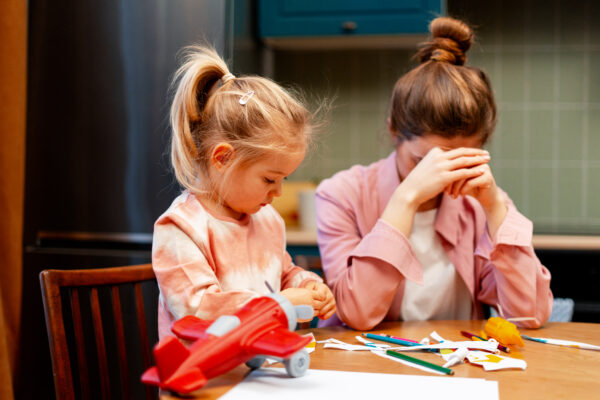
Overstimulation as a mom doesn’t always look like screaming. Sometimes it’s the tight feeling in your chest when the third person asks you something in two minutes. It’s flinching when someone touches you for the tenth time that day. It’s the way your jaw locks when the TV is too loud and someone is crying and dinner is burning all at once.
You might notice yourself snapping at small things that wouldn’t normally bother you. Feeling touched out, talked out, and completely done, even though you love your kids more than anything. You might have read every gentle parenting book and still find yourself reacting in ways you swore you never would.
This is overstimulation as a mom. And it is not a character flaw.
Your Brain Has a Security System: It Doesn't Care About Your Parenting Goals
Here’s what most parenting books don’t tell you: knowing what to do and being able to do it are two completely different things.
Your brain has three main operating layers. Think of them as a survival brain (brain stem), an emotional brain (limbic system), and a thinking brain (frontal lobe). When everything is calm, your thinking brain is in charge, the part that is patient, rational, and remembers everything you’ve learned about co-regulation and connection.
But when your nervous system senses threat, and that threat can be noise, chaos, overwhelm, or a toddler mid-meltdown, your survival brain takes over fast. The emotional brain floods with intensity. The thinking brain goes offline completely.
This is why you can know exactly what you should do and still not be able to do it in the moment. Your logical brain is temporarily unavailable. It’s not weakness. It’s biology.
Think of it this way. Most people abandon their New Year’s resolutions within the first two weeks, not because they don’t care, but because knowing a goal and having the excretive functioning skills to follow through are two very different things. Self-regulation lives in the thinking brain. When stress hijacks that brain, willpower disappears with it. The same is true in parenting.
Download Tantrum Tamer: Transform Chaos Into Calm
Knowing what to say in tough parenting moments is hard when your own nervous system is overwhelmed. The Tantrum Tamer App puts brain-based strategies, AI voice prompts, and guided breathing animations right in your hand so you don’t have to think — you just follow the lead. Learn more here.
Your Body Was Designed to Respond to Danger. Modern Mom Life Didn't Get That Memo.
When your nervous system senses a threat, real or perceived, it activates the fight, flight, freeze, or fawn response. This is your sympathetic nervous system doing exactly what God designed it to do. Your heart rate climbs, certain senses sharpen, digestion slows, and your logical thinking brain goes offline. Not a character flaw. A survival feature. The autonomic nervous system explains the full picture well if you want to go deeper on the science.
The problem is that your body cannot tell the difference between a bear and your child hitting you repeatedly while dinner burns on the stove. To your nervous system, overwhelming stress registers as threat. The response kicks in all the same.
Short visits to fight, flight, or freeze help us survive real danger. But modern mom life keeps many of us stuck there. When that happens long term, the effects show up as poor metabolism, brain fog, anxiety, disrupted sleep, and chronic illness. These are all signs of a nervous system that never gets to fully reset.
What we need most of the time is the parasympathetic state, often called “rest and digest.” This is where logical thinking lives, where patience actually exists, and where you can pause and choose your response instead of just reacting.
The good news is that we have real influence over this. When we reduce unnecessary sensory input, build in calming strategies throughout the day, and meet our own physical and emotional needs before the hard moments hit, we stay in that thinking brain state far more often. That is how we show up the way we know our kids need us to. In order to respond with the patience and intention we’ve worked so hard to learn rather than reacting from survival mode.
The Sensory Stack Every Mom Is Carrying
Managing overstimulation as a mom or dad starts with understanding what’s already filling your nervous system before the hard moments even happen. Before you interact with your child, your nervous system has been processing all day. The mental load of remembering everyone’s schedules. Physical touch that never stops: nursing, carrying, being climbed on. Background noise from morning to night. Emotional labor that never clocks out.
Each of those things is a small hit to your nervous system’s capacity. They stack. When the stack tips, you tip with it.
Many parents are also dealing with their own sensory sensitivities without realizing it. If certain sounds, textures, or levels of chaos affect you more than they seem to affect others, that’s not you being dramatic. Sensory processing differences are real in adults too. Our blog on signs of sensory issues in toddlers is aimed at kids, but many parents read it and quietly recognize themselves.
We Weren't Taught This. But Our Kids Need Us to Learn It
Most of us grew up in homes where self-regulation wasn’t a concept. Discipline was about behavior. If a child acted out, the response was correction, often loud, sometimes physical. Someone told us “we should know better.” Adults yelled at us for yelling. Spanked us for hitting. Told us to stop crying or they’d give us something to cry about.
Our parents were probably doing the best they could at the time. They simply parented the way their own parents raised them, without the brain science we have access to today.
But here’s what that means for us now: we are trying to model something we were never taught. That is genuinely hard. It doesn’t happen just because we read about it.
We would never expect a toddler who just learned to walk to run a race without practice. Yet we expect ourselves to completely rewire our stress responses through information alone, immediately, without support or repetition. That’s not how the brain works for anyone, at any age.
This is actually why so many well-meaning behavior strategies fail when parents are dysregulated. It’s not the strategy that’s broken. It’s that the strategy requires a thinking brain, and the thinking brain isn’t available when you’re in fight-or-flight mode.
This Is Not About Raising Passive Kids
There’s a misconception worth addressing directly.
Teaching children to breathe, to name their feelings, to pause before reacting, some people see this as raising soft kids. Kids who can’t handle hard things. That couldn’t be more wrong.
What we’re doing is teaching children to keep their thinking brain online during stress. So they can assess a situation, make a good choice, and respond rather than just react. That is the foundation of confidence. Of capable decision-making. Of kids who can handle difficult things because they have real tools, not just compliance driven by fear.
Choice-making is a skill. It requires a calm enough nervous system to access the thinking brain. When we regulate first and then offer choices, we’re building exactly that capacity in our kids.
This Is About Raising Self-Regulated Kids Through Co-Regulation
By teaching them how to cope with there big feelings and calm there nervous system, we are laying the foundation for higher learning skills. This will help the next generation learn how to plan, be more organized, focused, and follow through to achieve their goals. Learning to pause before responding activates the right side of the brain. This “brake pedal” handles self control, social connection, motor coordination and reduces.
We have to learn this ourselves first. You cannot model what you haven’t practiced. Guiding a child to calm when you are flooded yourself is simply not possible. The science is clear: a regulated adult is the single most powerful tool for helping a dysregulated child.
This is one of the core reasons I started Skidamarink Kids. Not because I was a bad mom, but because I was a mom who cared deeply and didn’t yet have what I needed to show up the way I wanted to. I believe God uses everything especially our struggles to help others. Our blog on child self-regulation goes deep on this, and it applies to adults as well.
Gentle Parenting Knowledge Is Not Enough on Its Own
Here’s something that comes up again and again when I talk with moms about overstimulation as a mom: you can know that you shouldn’t yell. You can understand attachment theory, watch every video, read every book, and have the co-regulation research practically memorized. And you can still lose it.
Not because the information is wrong. But because information lives in your thinking brain, and when you’re dysregulated, your thinking brain is not available. The knowledge is there. The access to it is temporarily blocked.
This is not a failure of willpower or character. It is how nervous systems work. And it means that the real work of parenting is not just learning more. It’s building the nervous system capacity to access what we know when we need it most.
Understanding that is where everything changes.
You're Not Alone in This
You found this blog because some part of you is trying to understand what is happening, not just to your child, but to you. That’s what dealing with overstimulation as a mom looks like: wanting to do better, and finally having the science to understand why. That awareness matters.
You love your kids. You want to show up as the parent you know you can be. And somewhere between knowing and doing, your nervous system gets in the way.
The good news is that you can change this. Not by trying harder. By learning to work with your nervous system instead of fighting against it.
Our next blog gets into exactly that: real tools for managing overstimulation as a mom in the moment, and daily habits that keep your nervous system out of the danger zone before you even get there. Many of the same strategies we share for kids in how to calm a child naturally translate directly to adults.
Read next: How to Deal with Overstimulation as a Mom: Tools to Regulate Your Nervous System (Coming Soon!)
The tools you need are closer than you think.
One of the hardest things about managing overstimulation as a mom is that the moments when you most need the right words are exactly the moments when your thinking brain goes offline. You know what you want to say. You just can’t access it when you’re flooded.
That’s the problem the Tantrum Tamer App was built to solve. Brain-based strategies and AI voice prompts are right in your hand, guiding you through what to say and how to respond in real time. No guesswork. No trying to remember what you read last Tuesday. Just clear, calm guidance exactly when you need it most, so you can stay regulated and show up for your child the way you actually want to.
The app also includes guided breathing animations designed to interrupt the fight, flight, freeze response for both kids and parents. Controlled breathing is one of the fastest ways to signal safety to your nervous system and bring your thinking brain back online. Having that visual right there in the moment means you and your child can reset together, which is exactly how co-regulation is supposed to work.
Want to know more about the approach behind all of this? The brain-based philosophy, the research, and why two pediatric therapists built a resource specifically for families like yours? Read our story here.
Looking for more? You might also love:
Why Your Child Can’t Self Regulate: The Hidden Brain Issue No One Talks About
Child Self Regulation: The Brain Balance Key to Success Every Parent Should Know
How to Help a Child with Sensory Overload: A Parent’s Guide
For More information on sensory processing and behavior support, see the Related Articles section below for more blogs!
– Kendra
Note to Parents
This blog is for informational purposes and not medical advice. My desire is to help you do what you can to support your child’s development in a natural way. Please reach out to your child’s pediatrician if you have developmental concerns.